
A software project needs a clear scope. Without one, it becomes difficult to estimate the work, manage expectations, measure progress, or know when something is actually finished.
But having a scope does not mean trying to build every possible feature in the first version.
At UTMIQ, we use a combination of clear project scoping and MVP thinking. We define what needs to be built, agree on the important requirements, separate essential features from future ideas, and then build against that agreed scope.
The goal is simple: build enough to solve the problem properly without allowing the project to grow indefinitely.
Scope is not the enemy
When people talk about MVPs, there can be a misconception that an MVP means building something quickly with very few requirements and figuring everything out later.
That's not how we approach it.
An MVP still needs a scope.
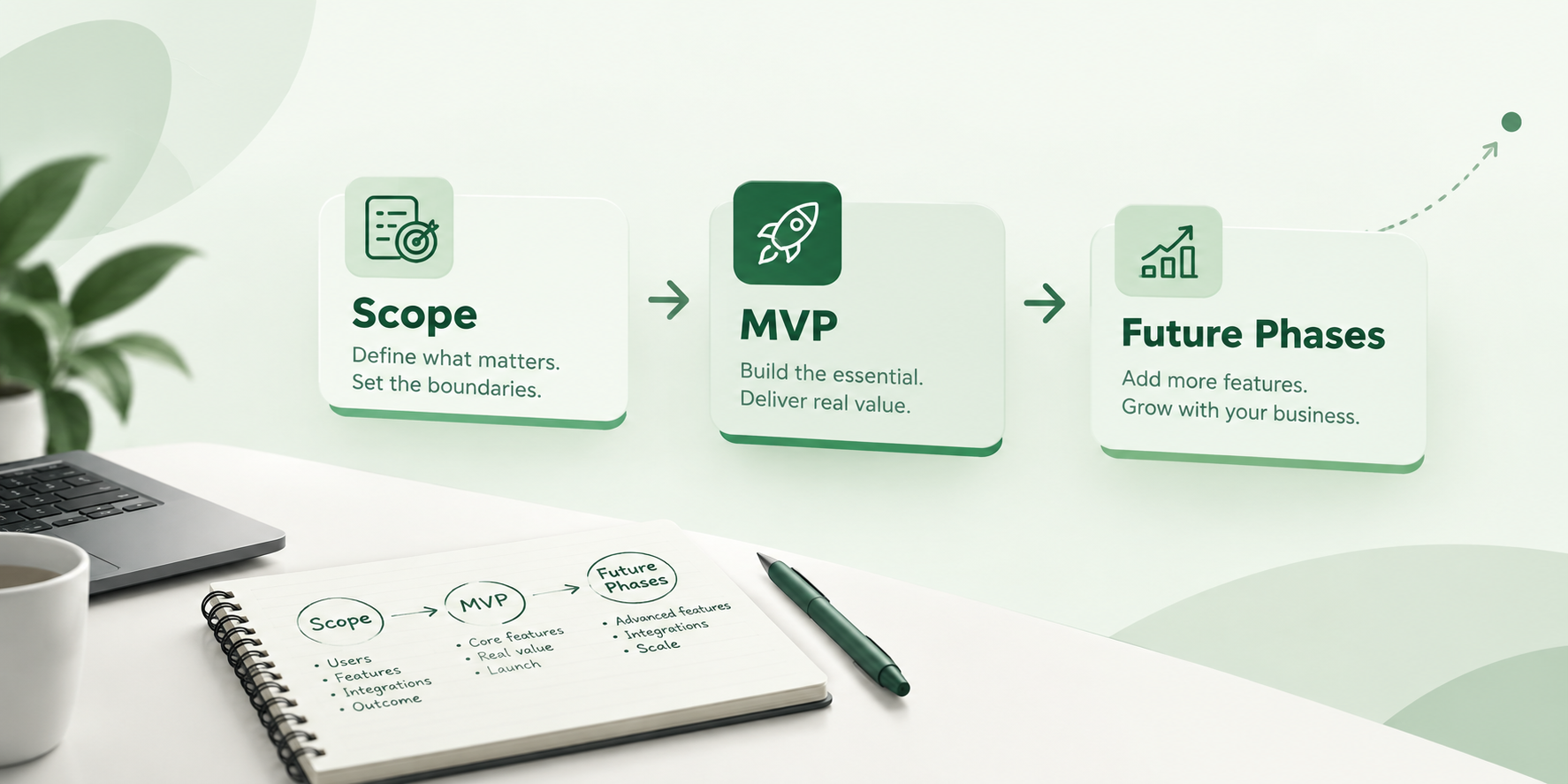
Before development starts, we want to understand the business problem, the users, the important workflows, the required integrations and the expected outcome. From there, we define the first version of the product and what is intentionally being left for later.
This gives the project boundaries while still keeping the first release focused.
The real problem is scope creep
Scope creep happens when new requirements gradually enter a project after the original scope has already been agreed.
A small additional feature might not seem significant on its own. Then another request gets added. Then another integration. Then a new dashboard. Eventually, the original project has become something much larger than what was estimated.
This affects development time, cost and delivery expectations.
It can also make the original goal less clear because the team is constantly moving between new requirements instead of completing the most important work.
That is why we treat scope as something to actively manage throughout the project.
MVP does not mean incomplete
An MVP should be the smallest version that can deliver the intended value.
That does not mean deliberately delivering a broken, unreliable or unfinished product.
If a feature is essential for the main workflow, it belongs in the MVP. If removing it would prevent the product from solving its primary problem, it should not simply be cut to make the project smaller.
At the same time, features that are useful but not necessary for the first release can often become part of a future phase.
This distinction is important.
The question isn't "What features can we remove?"
The question is "What does this product actually need to deliver its core value?"
We separate now from later
During scoping, we often identify ideas that make sense but do not need to be part of the first release.
For example, a business might initially need a customer management system with enquiries, follow-ups and basic reporting. During planning, we may also identify opportunities for advanced analytics, mobile applications, additional integrations or AI-powered automation.
Those ideas can be valuable.
But putting all of them into the first release can make the project unnecessarily large.
Instead, we can define the core product as the first phase and document the additional capabilities as potential future phases. This gives the client a clear understanding of what is being built now without losing sight of where the product can go later.
What happens when the scope changes?
Real projects can change. Sometimes a requirement becomes clearer after development starts. Sometimes a new business requirement becomes important. Sometimes technical discoveries require the original plan to change.
We don't treat every change as a problem.
Instead, we look at how the change affects the agreed scope, timeline and cost. If something is genuinely required, we can adjust the project accordingly. If it is a new feature that can wait, we can move it into a future phase.
The important part is that the change is visible and understood rather than silently expanding the project.
Fixed scope, flexible future
For projects with a defined scope, we provide clear milestones and a fixed quote before development begins.
This does not mean the product can never change. It means everyone understands what the current project includes.
Once that foundation is delivered, the product can continue to evolve through additional phases, improvements and new capabilities.
This approach gives businesses the predictability of a defined project while keeping the flexibility to build more when there is a real reason to do so.
Build what matters first
Good software development is not about fitting the maximum number of features into the first release.
It is about understanding the problem, defining the right scope, building the essential product properly and creating a foundation that can grow.
An MVP gives the project a clear first destination. A well-managed scope keeps the journey predictable. And future phases give the product room to become more capable as the business learns what it actually needs.
At UTMIQ, that's how we approach projects: clear scope, focused MVP, controlled changes and room to grow.
If you have an idea, an existing process that needs improvement, or a product you want to build, talk to UTMIQ on WhatsApp.
Define what matters. Build it properly. Then grow from there.